
 PIIGS- Some proposals by CESTES – PROTEO
A linguistic introduction
Pigs are lovely animals, though living in muddy places; Italians were once called “macaronis”, or “salamis” by the Frenchmen, with a duly accented last syllable. In a world socio-zoological rating pigs would be the poorer cousins of horses and cattle. Sort of terroni, to use an Italian word.
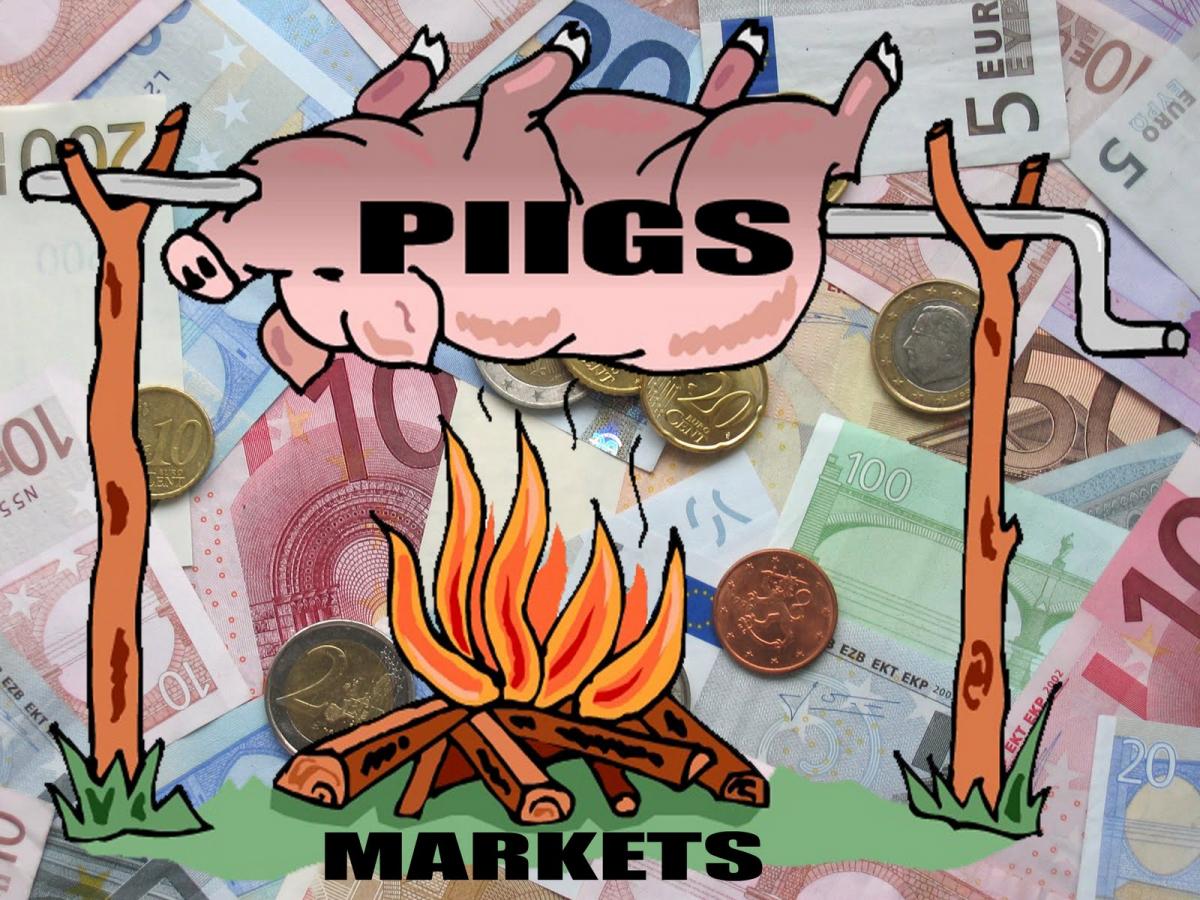
Thus Portugal, Italy, Greece and Spain are but the terruncielli, the pigs of Europe. Ireland has always been the white english colony, a South in the West. So Portugal, Italy, Ireland, Greece and Spain, with a doubled I for emphasis, are the PIIGS.
In the big business Europe, during official meetings, the offending word PIIGS is used to scorn, but also to keep the Mediterranean pigs inside Europe. They can always be used for expansion and ruling purposes. PIIGS, swine, is thus an usual term in the financial and media jargon. This pamphlet is a tribute to the pig. The most popular cuisine in the “developed” world is Italian. Italy has culinarily overcome Northern Europe, and the world’s best restaurant is in Spain, near Barcelona.
There is a wisdom in Southern Europe, civilization, exchanges with Africa an Near East, a political heritage of farmers and workers’ struggles, there is art, music and literature. It has Greece and Rome, the most popular saints, an ability to living in mixed cultures.
Today we have to invent an Europe which does not regard itself as a “power”, as a colonizing and bombing aircraft carrier. Europe has no competition in adapting and accepting.
If the piglets wake up they can build a different Europe, far from Frankfurt’s fog and cravings.
After all, with pigs nothing gets wasted.
This is a pamphlet about the current crisis of capitalist economy: its origins in 1971, starting from the USA, the recent history of European and Italian economy, the PIIGS (Portugal, Italy, Ireland, Greece and Spain) situation, and their chance to turn the crisis in an opportunity.
It is a radical criticism of the managing of the European Monetary Union (EMU), and to those who try to deal with it by war keynesism. As to Italy, a proposal to avoid the choice between Berlusconi’s lackeys’ economy and Prodi and Bersani big business managers’ economy.
A true opportunity to exploit together with other countries, in the same socio-economical-political situation: PIIGS.
Yves Coppens, the most famous European paleoanthropologist, who discovered Lucy, a scholar in human origins and evolution, stated that man is the only really generic animal, i.e. unspecialized to live in a specific environment. Human biological adaptation was extended to his cultural and technological evolution: his aircrafts fly higher than eagles. This pamphlet, written by two Italian and one Spanish economists, authors of many books, reminds us that we are, luckily, generic animals. Species can die out by a specialization excess.
The historical- critical synthesis effort by Vasapollo, Martufi and Arriola could be defined as follows.” Remember, man, that you can live in different situations, that you are able to transform the world around you without being limited by environment, costumes, and circumstances.
With this same genius you have created disasters, recklessly transforming your environment and adopted unsustainable production and consumption goals, scorning spirit and culture to achieve the goods which are now invading and choking you. You recently introduced precariousness, impoverishing peoples who formerly were considered rich. Besides creating false needs, you have reduced peoples like the Italians, who used to have a decent welfare state, to real poverty, with its drastic consequences. As you have been able to get yourself in trouble, now you can free yourself from your past mistakes, by accepting that other ways are possible”.
This pamphlet’s analysis is based on economic fundamentals, widening to anthropology, showing that in this crisis we can find an opportunity for a new way to consider the very wealth of a country or group of countries. This is the main issue of scholars like Iranian socio-anthropologist Majid Rahnema, in his recent work La potenza dei poveri, or philosopher Carlo Sini in his Del viver bene, and also the heritage of the recently deceased most popular woman in France, sister Emmanuelle, in her Ricchezza della povertà.
A race to wealth creates poverty, while another wealth lays with sustainable ways of life.
Many executives of this development system are not going to agree with this pamphlet. By executives we do not only mean managers, but also scholars, media men, people who advertise the current way of life.
A few pages cannot change mentalities and ways of living, but this pamphlet contains not only a mere analysis, but a real project.
The construens side of this work states how Italy, to quote British economist Hosea Jaffe, can temper its links to the “world company”, and how PIIGS can make a link among themselves, called ALIAS. This link can enable them not only to preserve, at least in part, the welfare state, and prevent the gap between rich who get richer and poor who get poorer, but also to implement less unequal exchanges in the surrounding area.
This proposal is now supported by the Centro Studi Economici e Sociali (CESTES) of the Unione Sindacale di Base (USB), member of the World Trade Union Federation (FSM).
Its target are of course the workers, but also media men and scholars, social workers, and whoever looks for a way out of the current situation.
Its final proposals are many: getting out of euro area, unleashing from the links with the world company and with those who defend a free-for-all liberism, reducing the goods import, promoting internal workforce, nationalizing banks, energy resources and services, equal exchange among PIIGS, an ALIAS similar to Latin American ALBA . We must remember that we do not know the end of it. Kerala, Bolivia and Ecuador , who can teach the whole world some useful socio-economical concepts, did not know it on start.
See the whole document

